



The Durable Love Guides — Complete Series
All nine Guides. Written by Jerry Wheeler, LMHC, NCC.
Most material written for couples is oriented toward fixing what is broken: better communication, cleaner repair, more constructive conflict. Some of that work matters. A lot of it misses what is actually happening in a partnership — which is usually not a communication problem and not a compatibility problem, but something structural that the ordinary vocabulary cannot quite name.
The Durable Love Guides are written for the territory the ordinary vocabulary misses.
Each Guide takes up a specific predicament couples recognize themselves in — the fight that keeps returning, the apology that did not land, the limitation being quietly grieved, the thinness that has settled into ordinary days — and draws a single clinical distinction with precision. The distinction, once in place, changes what kind of problem you understand yourself to be in. That shift in understanding is the precondition for the real work, which happens elsewhere, over longer timelines, and usually with support.
These Guides do not fix relationships. They do not promise transformation in thirty days. They do not offer techniques you can apply this weekend. What they offer is more unusual and, for the right reader, more useful: an accurate description of what has been happening, written in the register of someone who does this work for a living and has no interest in softening it.
There are nine Guides. Each stands alone. Together they describe what durable love is built from — and what, specifically, its absence looks like from inside.
Included in the complete series:
Guide 1 — Why You Keep Having the Same Fight. Managing a conflict vs. metabolizing it.
Guide 2 — Why You Can't Think Straight in the Middle of It. What happens in your body during conflict, and the threshold no technique can cross.
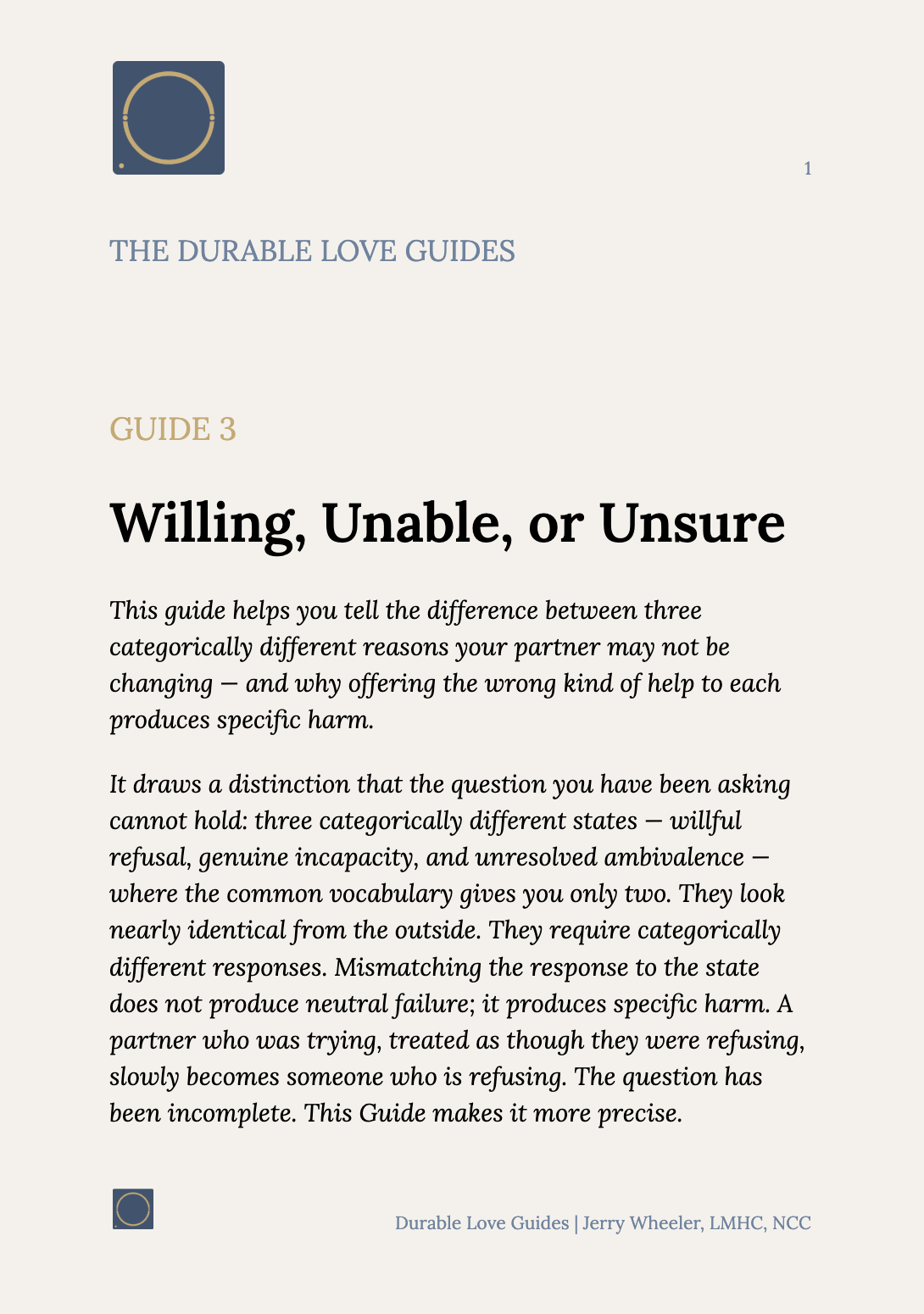
Guide 3 — Willing, Unable, or Unsure. Three categorically different states, often confused for two.
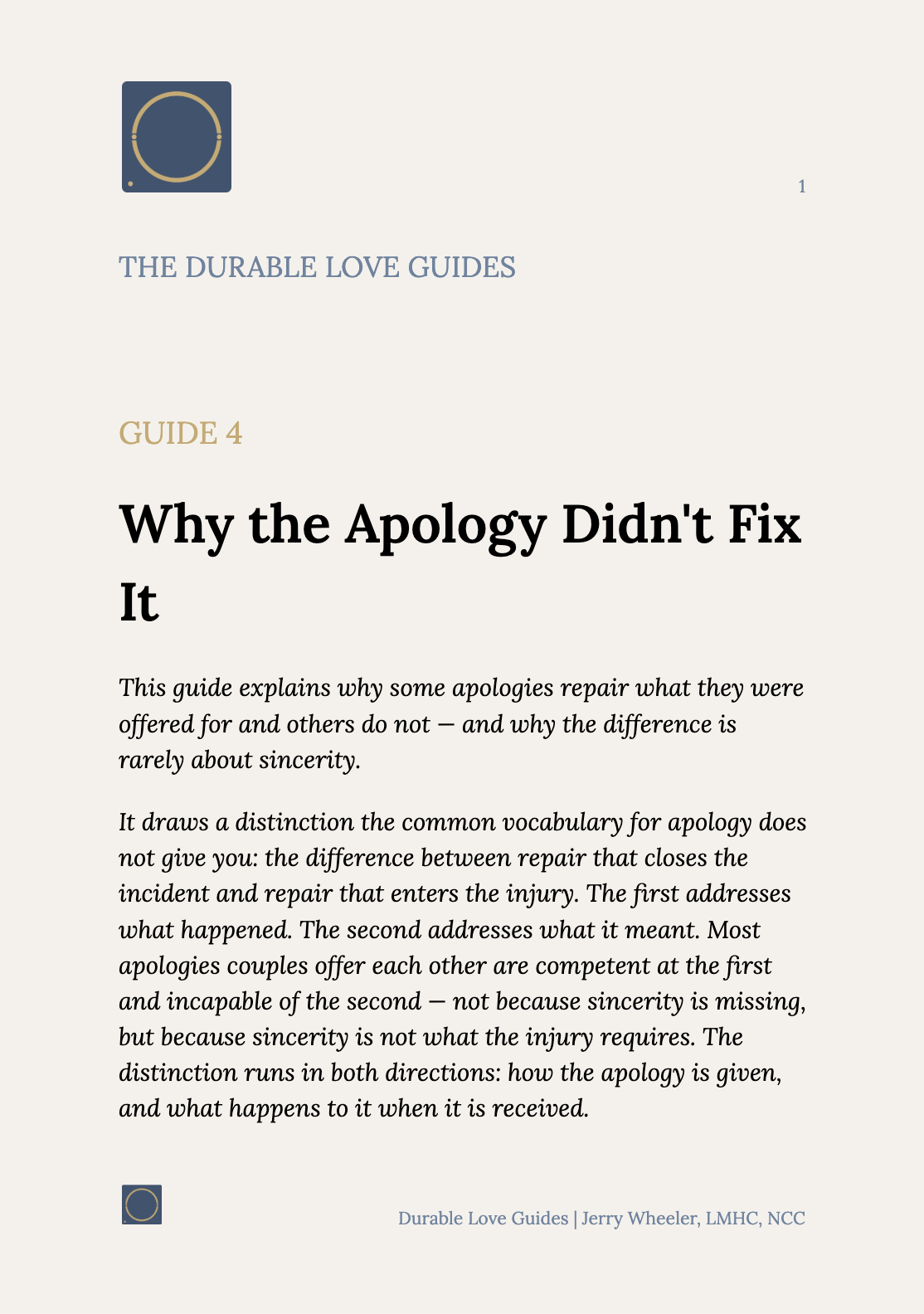
Guide 4 — Why the Apology Didn't Fix It. Repair that closes the incident vs. repair that enters the injury.
Guide 5 — Why You Get Defensive When Your Partner Is Hurting. A specific protective response, and what it would take to do something else instead.
Guide 6 — Why the Same Wound Keeps Reopening. Event wounds vs. accumulation wounds.
Guide 7 — When It's Not About What Happened. The grief of what your partner cannot give you.
Guide 8 — What Commitment Actually Looks Like. Commitment as a status vs. commitment as a stance.
Guide 9 — Staying Connected When Nothing Is Wrong. The plateau that settles into partnerships where nothing is particularly wrong.
Approximately 78,000 words across the nine Guides. Each is a substantial standalone artifact (between 6,000 and 9,500 words) designed for slow reading, with a substantial reflection instrument at the end of each that you can work through alone or with your partner. PDF format. Delivered immediately upon purchase as a single archive containing all nine Guides.
The complete series is offered at $79 — a savings of $20 over purchasing the nine Guides individually.
Written by Jerry Wheeler, LMHC, NCC — a licensed couples therapist based in Indiana and the developer of the Durable Love Method, a comprehensive clinical framework for how long partnerships actually hold.
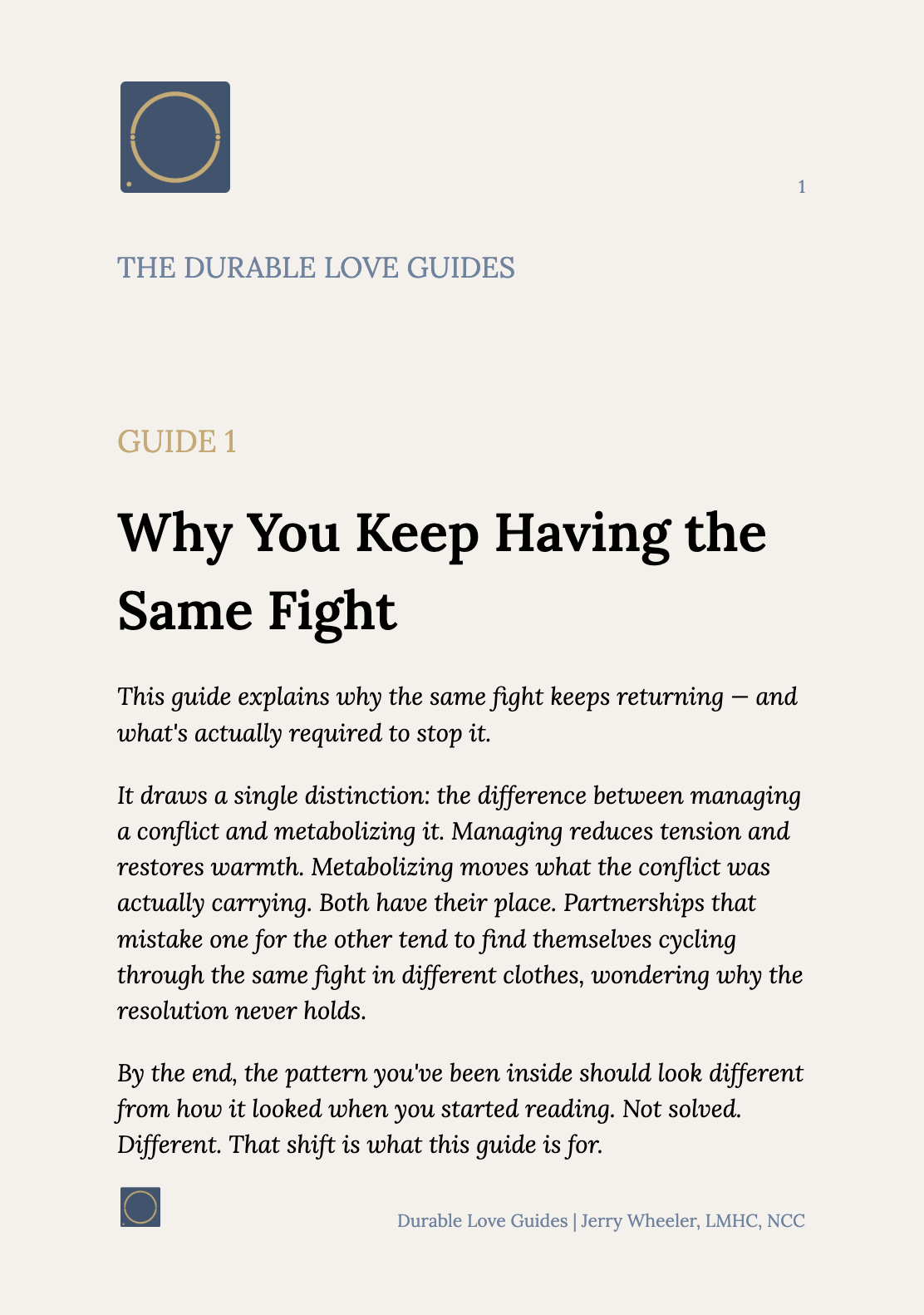
From The Durable Love Guides — a nine-Guide series for couples, written by Jerry Wheeler, LMHC, NCC. The Guides take up specific predicaments couples recognize themselves in and draw a single clinical distinction with precision. They are not techniques. They are accurate descriptions of what is actually happening — written in the register of someone who does this work for a living and has no interest in softening it.
You know this fight. Not this version — the fight itself. The one that returns in slightly different clothes, around slightly different content, but arriving at the same place every time.
You have tried what you know to try. You have talked about it, apologized, recommitted. You have made progress that did not hold. And the fight keeps returning, and you cannot quite tell why.
This Guide names why. Most couples in this pattern are practicing something called managing — reducing tension, reaching resolution, restoring warmth. Managing works. It keeps things functional. What it does not do — what it was never designed to do — is move what the conflict was actually carrying. The distinction between managing a conflict and metabolizing it is the difference between a fight that ends and a fight that finishes. And it is the difference the common vocabulary for relationships has not been giving you.
The Guide draws the distinction carefully, illustrates it through a couple you will probably recognize, and offers a reflection designed to help you see, with more precision than the pattern usually allows, what has actually been happening in your own recurring conflicts.
This is Guide 1 of 9 in The Durable Love Guides series. Each Guide stands alone. Together, they describe what durable love is built from.
Each Guide takes up a specific situation couples recognize themselves in — the fight that keeps returning, the apology that did not land, the limitation being quietly grieved, the thinness that has settled into ordinary days — and names what is actually happening, in language couples have usually not had access to before.
Once you have an accurate description of the pattern you are in, the pattern becomes workable.
Misnamed, it stays stuck.
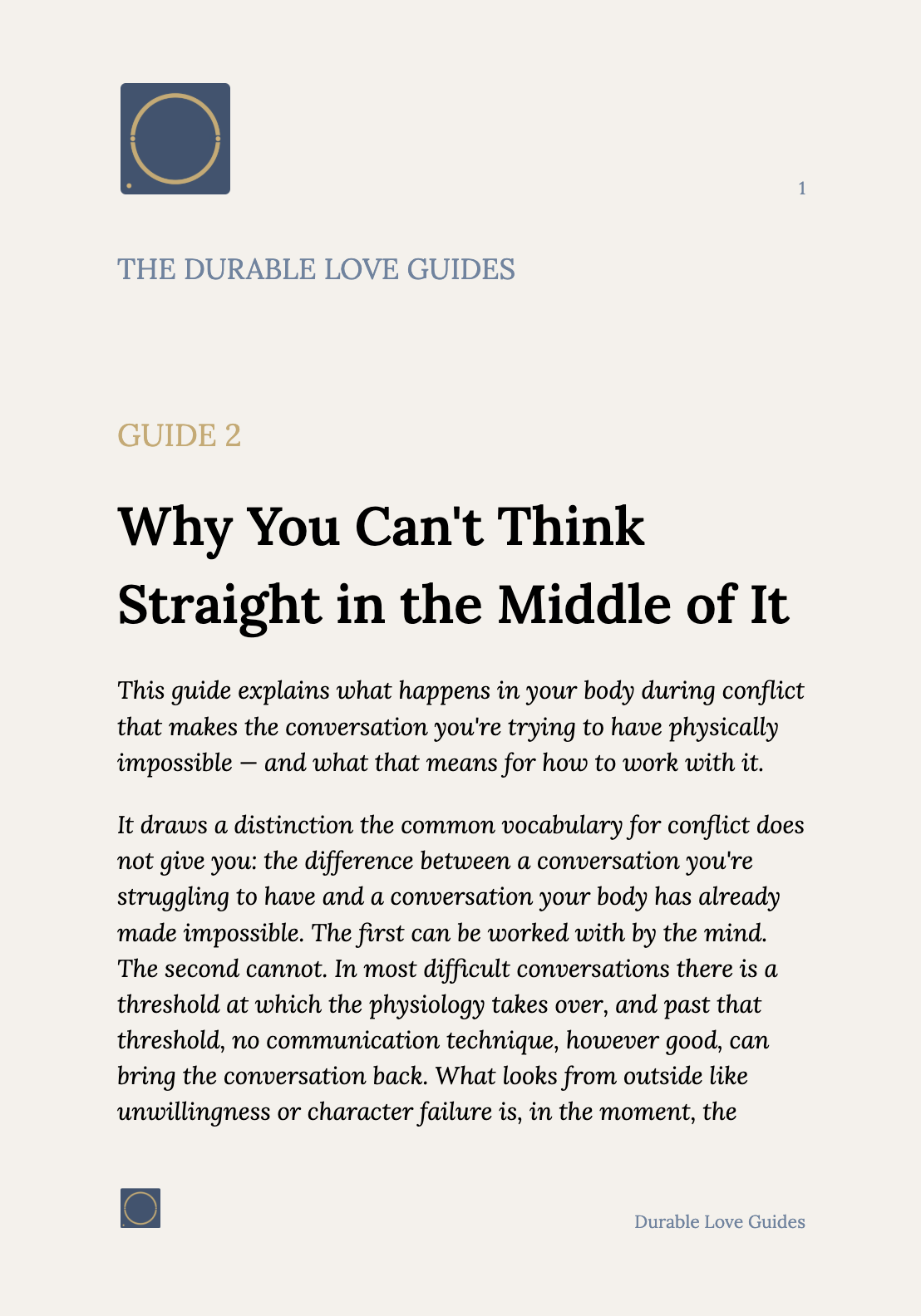
From The Durable Love Guides — a nine-Guide series for couples, written by Jerry Wheeler, LMHC, NCC. The Guides take up specific predicaments couples recognize themselves in and draw a single clinical distinction with precision. They are not techniques. They are accurate descriptions of what is actually happening — written in the register of someone who does this work for a living and has no interest in softening it.
There are conversations you and your partner begin that become, somewhere in the middle, impossible to have. One of you says something you did not mean. One of you stops being able to take in what the other is saying. Afterward — sometimes only minutes later — you may find yourself bewildered by what you just did, because the person who did those things does not match the person you know yourself to be.
This Guide is about what happens in those moments. Specifically: the physiology that produces the behavior, the threshold at which the physiology takes over, and the reason no communication technique, however good, can work past the threshold once you have crossed it.
The material is usually treated as if it were character — as if your behavior in hard conversations revealed something about who you are underneath. It does not. It reveals something about what your nervous system does under activation, which is different and which is addressable through different kinds of work than the communication frame can offer.
The Guide renders the experience from inside and from across, distinguishes between windows that narrow from practice and windows that are constitutionally narrower, and orients you toward the specific work that widens what can be widened.
This is Guide 2 of 9 in The Durable Love Guides series. Each Guide stands alone. Together they describe what durable love is built from.
The Durable Love Guides
Nine Guides for couples, written by Jerry Wheeler, LMHC, NCC.
The Durable Love Guides
About the format
Each Guide runs between 6,000 and 9,500 words and closes with a reflection you can work through alone or with your partner. PDF format, delivered immediately upon purchase.
Individual Guides are $11. The complete series is 20% off at $79.

Most material written for couples is oriented toward fixing what is broken: better communication, cleaner repair, more constructive conflict. Some of that work matters. A lot of it misses what is actually happening in a partnership — which is usually not a communication problem and not a compatibility problem, but something the ordinary vocabulary cannot quite name.
The Durable Love Guides are written for the territory the ordinary vocabulary misses.
Each Guide takes up a specific situation couples recognize themselves in — the fight that keeps returning, the apology that did not land, the limitation being quietly grieved, the thinness that has settled into ordinary days — and names what is actually happening, in language couples have usually not had access to before. Once you have an accurate description of the pattern you are in, the pattern becomes workable. Misnamed, it stays stuck.
These Guides do not promise transformation. They do not offer techniques you can apply this weekend. What they offer is more useful: an accurate description of what has been happening between you.
There are nine Guides. Each stands alone. Together they describe what durable love is built from.

Have Questions?
We'll review your message and get back to you within 48 hours.