

 Image 1 of 1
From The Durable Love Guides — a nine-Guide series for couples, written by Jerry Wheeler, LMHC, NCC. The Guides take up specific predicaments couples recognize themselves in and draw a single clinical distinction with precision. They are not techniques. They are accurate descriptions of what is actually happening — written in the register of someone who does this work for a living and has no interest in softening it.
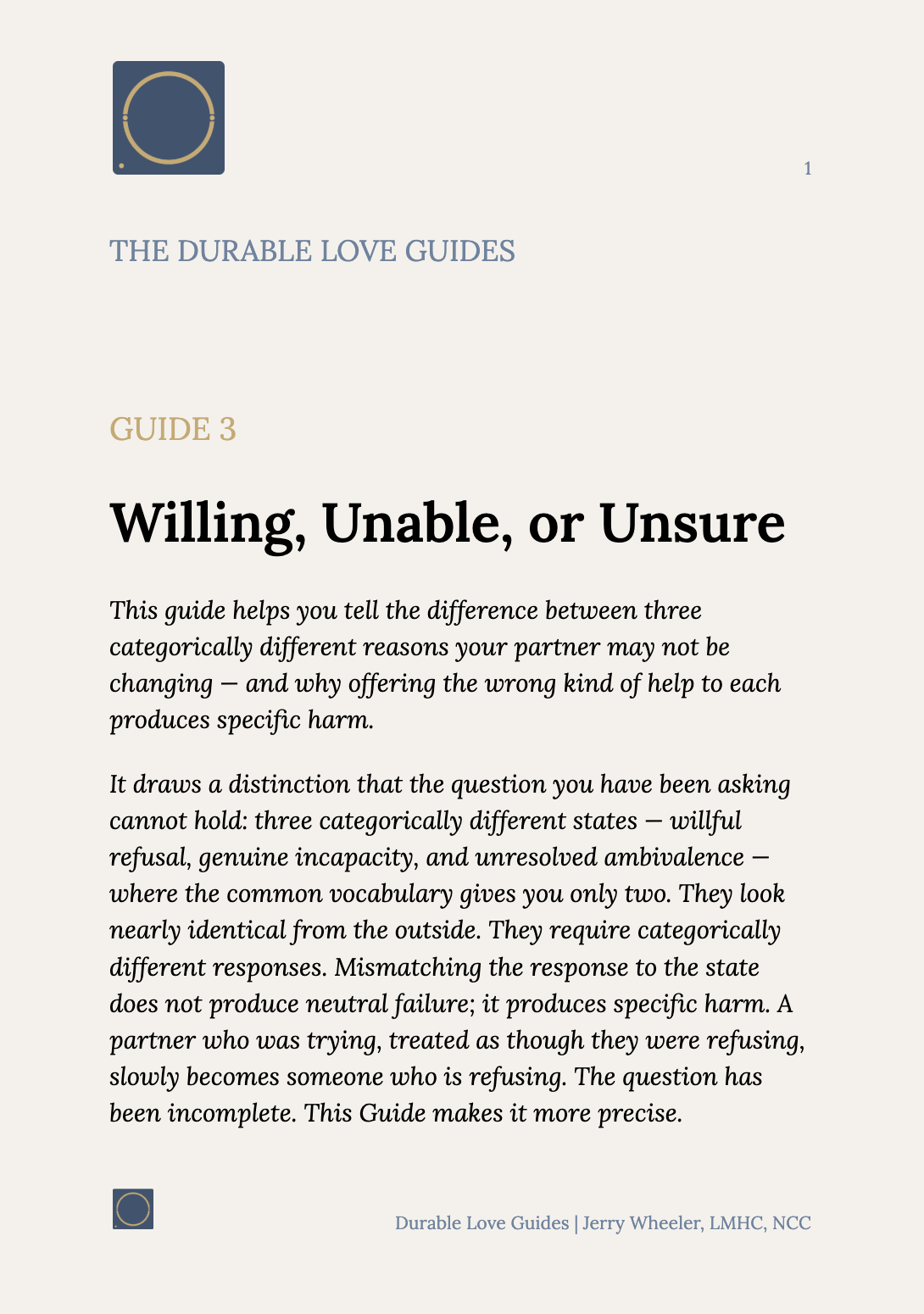
When your partner is not giving you what you have been asking for, one of the most consequential distinctions in adult partnership is also one of the hardest to make accurately: are they unwilling, unable, or genuinely uncertain?
The three look similar from outside, particularly early on. They require categorically different responses. Mismatching the response to the category does not produce neutral failure — it produces specific harm. Treating a can't as a won't causes the partner who was trying to internalize the frame of refusal and slowly become someone who is refusing. Treating a won't as a can't produces endless patient support for a position that is not moving and was never going to. Treating ambivalence as unwillingness turns ambivalence into unwillingness — the partner who was uncertain hardens into refusal under the pressure of being treated as though the decision had already been made.
This Guide renders the three states precisely, describes the signature of each, and names the clinical harm of each misidentification. It is written in the register of someone who has watched couples waste years addressing the wrong category — and who has also watched what happens when the category gets named accurately.
The Guide does not tell you which category your partner is in. It gives you a sharper way of observing and points toward the specific work each category requires.
This is Guide 3 of 9 in The Durable Love Guides series. Each Guide stands alone. Together they describe what durable love is built from.
From The Durable Love Guides — a nine-Guide series for couples, written by Jerry Wheeler, LMHC, NCC. The Guides take up specific predicaments couples recognize themselves in and draw a single clinical distinction with precision. They are not techniques. They are accurate descriptions of what is actually happening — written in the register of someone who does this work for a living and has no interest in softening it.
When your partner is not giving you what you have been asking for, one of the most consequential distinctions in adult partnership is also one of the hardest to make accurately: are they unwilling, unable, or genuinely uncertain?
The three look similar from outside, particularly early on. They require categorically different responses. Mismatching the response to the category does not produce neutral failure — it produces specific harm. Treating a can't as a won't causes the partner who was trying to internalize the frame of refusal and slowly become someone who is refusing. Treating a won't as a can't produces endless patient support for a position that is not moving and was never going to. Treating ambivalence as unwillingness turns ambivalence into unwillingness — the partner who was uncertain hardens into refusal under the pressure of being treated as though the decision had already been made.
This Guide renders the three states precisely, describes the signature of each, and names the clinical harm of each misidentification. It is written in the register of someone who has watched couples waste years addressing the wrong category — and who has also watched what happens when the category gets named accurately.
The Guide does not tell you which category your partner is in. It gives you a sharper way of observing and points toward the specific work each category requires.
This is Guide 3 of 9 in The Durable Love Guides series. Each Guide stands alone. Together they describe what durable love is built from.